Scott Hasbrouck
Founder & CEO
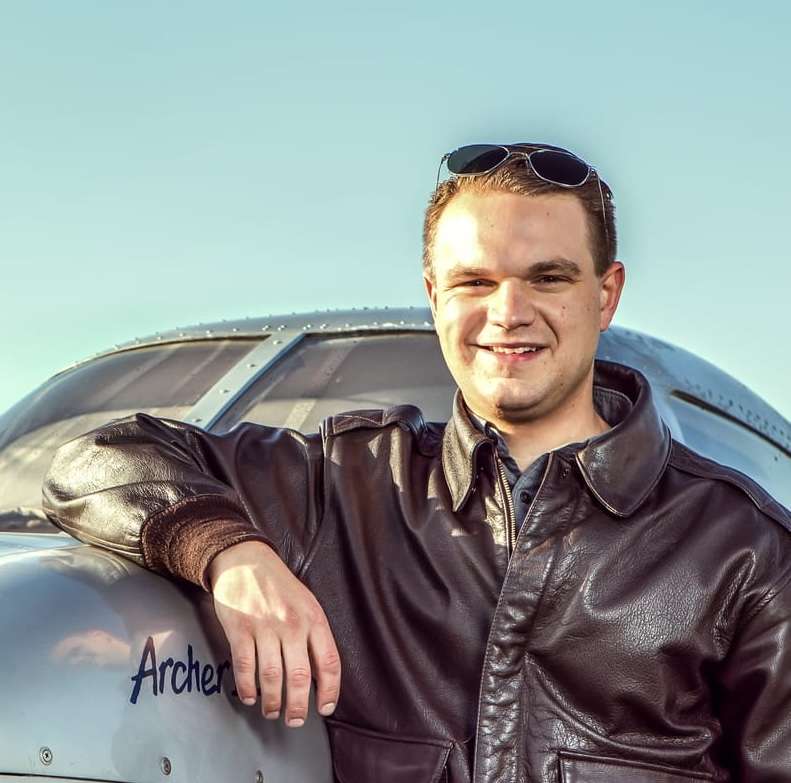
Scott Hasbrouck founded Orcrist in February 2025 to address a critical vulnerability in modern warfare: the absence of affordable, rapidly deployable autonomous air defense systems capable of protecting troops and infrastructure from emerging aerial threats. His path to aerospace defense leadership combines deep technical expertise in spacecraft systems, a proven track record of building and scaling companies, and a lifelong commitment to engineering solutions that protect people.
Engineering Roots in Michigan
Scott's engineering journey began in the 1990s in a middle-class Michigan household, where he learned welding and soldering working alongside his father and taught himself programming on salvaged computers. At twelve years old, he discovered a discarded HeathKit HERO-1 robot and, without a manual or internet tutorials, reverse-engineered the system and handwrote control code in hexadecimal—his first experience making autonomous systems respond to human intent.
Those same formative years saw Scott devoting thousands of volunteer hours to the Michigan Space & Science Center in Jackson, where he advanced through high-power rocketry certifications and helped establish the Jackson Model Rocketry Club. A defining moment came during a full-day mentorship with astronaut Jack Lousma, which crystallized his understanding that rockets and spacecraft weren't just fascinating machines—they were complex, unforgiving systems requiring precision, rigor, and flawless execution.
From Molecules to Silicon Valley
After completing undergraduate education, Scott pursued graduate studies in physical chemistry at the University of Georgia (2010-2012), specializing in molecular spectroscopy of cold ions using molecular beam mass spectrometry. The work demanded extraordinary precision, analytical rigor, and first-principles thinking—skills that would later prove essential when designing flight control algorithms and guidance systems.
Following graduate research, Scott entered Silicon Valley's high-velocity startup ecosystem, participating in Y Combinator twice: Summer 2016 and as Chief Technology Officer in Winter 2021. Through multiple ventures and acquisitions, he refined his ability to build lean, technically sophisticated teams capable of rapid iteration and delivery under severe resource constraints. This execution discipline would become central to Orcrist's development approach.
Aerospace & Innovation
By 2019, Scott was working on NASA and USSF research projects as a software architect. He later invented a novel 5G-NTN (Non-Terrestrial Network) technology and served as CTO, designing and deploying two satellites. Scott holds 15 patents (pending/issued) across aerospace systems, autonomous control, and communications technologies.
In late 2024, during solo travel through Arctic Norway, a technical breakthrough crystallized: GPUs had shrunk to the size to fit inside hobby high-power rockets. Computer vision + autonomous guidance + man-portable form factor—all technically feasible for the first time. The front lines were calling. Scott founded Orcrist in February 2025.
TRL-6 in Eight Months
By October 2025—just eight months after founding—Orcrist achieved Technology Readiness Level 6: a functional prototype successfully demonstrated in a relevant operational environment. This timeline is exceptional in aerospace and defense. The speed reflected the skunkworks organizational model and Scott's conviction that iterative development with rapid hardware testing reveals problems and solutions far more efficiently than attempting to anticipate every challenge through analysis alone.